


Profound Life defies expectations
A general description of Rachel Morrison’s Love of Your Life would surely do it a disservice. At first blush, one would think it is nothing more than an overwrought romance replete with a pair of star-crossed lovers, a nearly unbearable tragedy and new hope found in the arms of someone new. While all of these elements are present in Julia Cox’s emotionally dense script, there’s far more at play. Grief is the catalyst of this timely drama that focuses not so much on romance but the tapestry of life itself. Sincerely told and passionately performed, the movie ultimately reveals itself to be a celebration of life and all the joys and sorrows it contains.
As far as meet-cutes are concerned, Cox concocts one that doesn’t stretch credulity. Boston nurse Maya (Margaret Qualley) answers a personal ad regarding a small bureau that’s for sale. Stopping by the apartment of Jason (Gabriel Basso), who owns said piece of furniture, she’s attracted to his awkward advances and ultimately accepts his invitation to go out to dinner. A connection is made and a whirlwind romance ensues. Soon, he is introducing him to his parents, a wedding takes place and domestic bliss becomes the order of the day.
Then, Jason falls victim to the COVID-19 pandemic.
Having been hesitant to enter into a relationship, Maya is bereft and rudderless. Fleeing to Europe, her life becomes a downward spiral of self-destructive behavior. Numb to her pain but unable to forget Jason, she drifts from one one-night stand to the next, giving no thought to healing her body or soul. However, an encounter with Felix (Aaron Pierre), a Londoner on vacation, awakens something in her.
As I say, this sounds like a standard romance. However, the way in which the story is realized and the way in which the instances that make it up are presented result in a somewhat profound meditation on life. Scenes featuring birthdays, family gatherings, a random Halloween, meetings with friends and myriad other instances, special and mundane, are presented not so much in an offhand manner, but rather as moments that make up a life. As they occur, Maya, like so many of us, applies no special significance to them. Only after Jason is gone does she realize their true importance. The most important part of her journey toward health is to appreciate life and all it contains, whether they be moments of elation, despair or indifference.
The scenes between Qualley and Pierre manage to be solemn but never too heavy, the duo creating sincere interactions that smack of an intimacy that’s almost uncomfortable to witness. The film’s first act featuring Qualley and Basso has a similar honesty to it as well, and as a result, this trio of characters ring true and we can’t help but care for them.
I would be remiss if I did not mention screen veteran Catherine Keener who appears as Charlie’s mother. Though her screen time is brief, the actress makes an impact, as she always does. A third-act moment in which Maya visits her for the first time, some six years after her son’s death, results in a gripping, cathartic confrontation between the two in which harsh truths are shared and souls laid bare. The resolution that results rings true thanks to the sincerity the performers bring to the scene.
An important aspect of the film is the way it champions mental health initiatives. As a nurse, it takes some time for Maya to seek out the avenue that will lead to her salvation. That she ultimately becomes an outspoken advocate for self-care is a timely message Cox naturally weaves into the narrative, one that rings true and proves vital to the character’s development.
An audio cassette made by Charlie, the sound of which is deteriorating each time Maya listens to it, proves to be a powerful metaphor for their relationship. Though its physical nature is becoming obsolete, the music it contains will forever be in her mind. Love powerfully reminds us that our identity is formed by memory and experience but that none of that is fixed. Each day offers its own opportunities, and our life is to be cherished for all it has to offer. While our experiences may form us, it’s how we perceive them that matters. Streaming on Amazon Prime.
Lack of passion takes little “Sense”
In a recent interview regarding her adaptation of Sense and Sensibility, director Georgia Oakley said, “I wanted to tell a relaxed, understated version of the story.” After sitting through her flat version of the Jane Austen classic, I can say she achieved her goal to the film’s detriment.
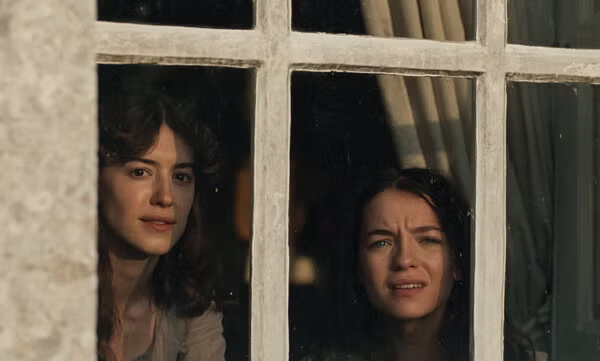
What with six direct adaptations of the novel having been done for the movies and television and numerous off-shoot versions (my favorite is Scents and Sensibility, which deals with scented lotions), it makes sense to try and find a fresh approach. But the question to be asked before even considering such an endeavor is if a new version is needed? Ang Lee’s 1995 version starring Emma Thompson and Kate Winslet as the Dashwood sisters and Hugh Grant and Alan Rickman as their love interests is considered the definitive take of the Austen novel, the one which all subsequent productions will be compared to. As such, Oakley’s film pales in comparison to it at every turn.
For those who relied on CliffsNotes to get through the book in their English literature class or others who have somehow managed to avoid all things Austen, a brief summary is necessary.
After their father dies, sisters Elinor, Marianne and Margaret Dashwood, as well as their mother, are evicted from the palatial home. According to British law, all property goes to the eldest son of the family, which in this case would be John, a child born in a previous marriage. With nowhere to go, this quartet of orphans of the storm move into a modest cottage on the estate of their cousin, Mrs. Jennings. Once settled, the two eldest daughters draw the attention of three eligible bachelors, Edward Ferrars, John Willoughby and Colonel Brandon. Flirting ensues, sparks fly, confusion erupts, secrets are revealed and ultimately, love conquers all.
For the most part, Diana Reid’s adapted screenplay follows this outline, the only addition being a duel that was only alluded to in the original text. The biggest change is the rather contentious exchanges between Elinor and Marianne which make obvious their different attitudes toward life. While the latter is cautious and uses common sense to reason through problems, the latter’s sensibility or sensitivity leads to rash decisions and judgments. The emphasis on the sibling’s differences is the most distinctive thing about this version, adding more dramatic tension and drawing a clear distinction between the two that, for the most part, has been absent in previous iterations.
As Elinor and Marianne, Daisy Edgar-Jones and Esme Creed-Miles are fine, their occasional fiery moments, standing out in this bland landscape. Their romantic partners, played by George MacKay (Ferrars) and Herbert Nordrum (Bandon), are as effusive as an exhausted sloth. Timid and quiet in their approach to their roles – or because of Oakley’s direction of them – they seem barely awake at times, a far cry from being alive with passion. There’s nary a spark kindled between either couple and I came away with a sense these were more relationships of convenience rather than examples of ardent love.
Also leeching away any sense of feeling is the director’s insistence on shooting many indoor scenes with natural lighting. Cinematographer Arnaud Potier casts a pall over every room, shadows dominating at times, giving forth the impression we’ve wandered into Emily Bronte territory and are watching Wuthering Heights, instead. Visual bridges of spider’s spinning webs, quiet views of meadows and other esoteric matters go a long way towards underscoring the languid pacing of an ordinary day in the early 19th century. However, they contribute nothing to the narrative momentum.
While these steps are commendable in Oakley’s pursuit of historical accuracy, they result in a flat, listless movie. Pedestrian direction and an overall lack of passion aren’t what we’re looking for in films like these. We go to live vicariously through Elinor and Marrianne as they discover an all-consuming love we all wish for. We go to be swept away, to be caught up in the romantic fantasy that have made Austen and Bronte’s works so popular. The realism in Oakley’s Sense and Sensibility will please experts on English society of the 1800s. Tedium is all to be had for those seeking romance. In Theaters.
Courage and fortitude at the core of Tenzing
Time has a way of diminishing the impact of things, and while that might be advantageous where a broken heart is concerned, it does a disservice to great accomplishments, both public and private. I was reminded of this while watching Jennifer Peedom’s Tenzing, a film that goes a long way toward reminding the viewer what a great feat climbing Mount Everest for the first time was on both an international, as well as personal scale. Shot on location in Nepal, the director is able to capture the wonder and danger of the environment, effectively underscoring the constant peril the climbers were in as well as why the mountain drew them to attempt such an astounding feat.

We first meet Tenzing Norgay (Samdrup Dorje Lama) in 1924 as a 9-year old boy, mystified by the visitors who’ve come to the Tibetan Plateau where he and his family live. There he meets George Mallory (Johnny Flynn), the leader of the first Everest expedition, an encounter that will impact the rest of his life. Having always been mystified by the massive mountain that looms over his village, the actions of the expedition plant notions in his mind that grow nearly into an obsession.
Luke Davies’ script then jumps back and forth on the timeline of Norgay’s life, the famous attempt of 1953 being the anchor from which flashbacks showing events from the titular character’s youth and as a young man. We see him abandoned by his family, fall in love with Dawa (Thinley Lhamo), a woman who is socially out of his reach, and attempt to come to terms with a profound familial tragedy. The portrait that emerges is of a man battling not only his inner doubts, but societal prejudices due to his poverty and standing in his community.
Portrayed by Genden Phuntsok as an adult, Norgay is seen as a pensive, damaged but determined man who, if nothing else, has a sense of fortitude that drives him to achieve his goal of climbing Everest. For him and the other Nepalese Sherpas hired by the expedition, the mountain is akin to a deity, one that must be honored not conquered. Their climbing is a spiritual quest, not some grand act of hubris. The script does a fine job of driving this point home without belaboring it, the Brits’ colonial attitude and subtle sense of superiority obvious to all but them.
Seeing the friendship that develops between Norgay and Edmund Hillary (Tom Hiddleston) is one of the film’s most satisfying elements. What begins awkwardly grows into a relationship based on mutual respect and admiration. The various trials they endure as they ascend, the difficulty of which Peedom and Davies take great pains to emphasize, are at times seemingly minor events. Yet, they are always based on the humanity of each man, their strengths and flaws shown and accepted by the other. Phuntsok and Hiddleston are each subtle in their approach, giving their moments a sense of sincerity, making the pairs’ ultimate triumph, all the more moving.
Released in theaters in larger cities, this is a film that should be seen on the biggest screen possible. Instead of the latest empty superhero epic being shown in IMAX theaters, this is the sort of feature that should be on display in that format. Still and all, it’s a visually spectacular piece of work, the setting capturing all of Everest’s grandeur and power. The sights on display and the genuine performances from the cast ensure that Tenzing achieves its goal of putting the accomplishments of these men, particularly their courage and fortitude, in proper perspective. Streaming on Apple TV+


