


Truth proves elusive in See
“Remember, as a documentarian you are an observer, an author but not a director, a discoverer, not a controller.” – Albert Maysles.
I suppose that’s one way of looking at what the role of a documentary filmmaker is. Maysles and his brother, David, have adhered to this philosophy with great success, having made genre classics such as Salesman (1969), Gimme Shelter (1970) and Grey Gardens (1975), as well as many others, capturing events and presenting them as they witnessed them. But of course, that doesn’t necessarily mean they’re telling us the truth.
The role of the documentary filmmaker, and just how honest this format is, has been called into question since the first feature-length example Nanook of the North hit screens in 1922. Though its director Robert J. Flaherty insisted all that was on the screen was true, further investigation revealed he had his titular subject stage many of the filmed sequences. The director’s reasoning was he was only reenacting things he knew did happen in a more dramatic way. This was just enough to cast doubt on the format and thus was the beginning of the genre being looked at with a skeptical eye.
The narrative of such films can be shaped as much by what the filmmaker leaves out as much as what is included, while the question of perspective is always called into doubt, especially where subjects regarding politics or society are concerned. Michael Moore has made a career out of taking an unapologetic stance in his films, using his version of the “truth” to champion a variety of causes.
Director Nathan Fielder’s intent with his film You Can See Everything is to muddy the waters between what is fact and fiction even further. With the exceptions of The Odyssey and Digger, there’s no other movie this year that’s generated as much hype or polemic discourse. Initial interest was stoked when it became known Elizabeth Holmes, the disgraced and convicted corporate head of Theranos Corp., would be Fielder’s subject. However, since its release, much of the conversation has focused on the filmmaker’s obvious manipulation of the material he’d captured.
To be fair, Fielder hides nothing where his process is concerned. We see him enter the Holmes’ household, where he lived with her, her partner Billy Evans and their two small children during the 34 days leading up to the beginning of her prison term. The first half of the movie plays like a straight doc, as we see the couple go about their daily lives, all the while trying to resurrect their careers and reshape the public’s perception of Holmes.
However, once the 34 days pass, Fielder completely abandons the constraints of the genre and the film becomes something else altogether. More a reality-based entertainment, See morphs into a mind-bending game of manipulation that plays out not only on the screen but between the director and the audience as well.
Granted, the relationship between the filmmaker and viewer has always been based on manipulation, whether it be a work of fact or fiction. Yet, what Fielder does here is shatter that tacet agreement, openly toying with our perceptions of what we have seen and what we have not. He should be given credit for being so open about his intent and process. If he should receive praise for his machinations and the way in which he treats his subjects is open to question.
As we watch See unfold, the viewer finds themselves in the company of three master manipulators, each with their own agenda, which they are prepared to move forward at any cost. Fielder’s focus is the movie, Holmes is to clear her name and Evans … well, the less said the better.
I’ve rarely heard so much talk that amounts to nothing. Half-truths, vague facts and grand promises are bandied about by Holmes and Evans as they try to resurrect Theranos under a different name. As they wheel and deal online and via telephone, it’s easy to see how so many were initially duped by Holmes. Fielder is no less guilty, as his line of questioning toward Holmes is at times purposely vague, as if he is setting out to confuse her. That he does not phrase things more simply seems a calculated ploy to make her look foolish. As for the conversations between Fielder and Evans, all they say is calculated and guarded, neither of them wanting to divulge their intentions. None of it and no one is to be taken at face value at any point.
Regarding Holmes, surprisingly she comes off as the most sympathetic of the lot. Keep in mind, that standard is low as set by this trio. By no means does Fielder imply she’s innocent of the fraud charges leveled against her, but there’s something amiss regarding how she sees herself and her situation. If nothing else, you’ll likely come away with the notion that she’s firmly convinced she’s telling the truth. Her utter conviction in this is what makes her so beguiling and dangerous.
Its obvious Fielder is captivated by her, mystified by Evans and blinded by hubris. The film runs far too long, the director repeatedly beating a dead horse long after making his point. If nothing else, he has created an intriguing, curious three-pronged character study, while the film’s title is revealed to be purposely misleading. While See clarifies some things regarding Holmes, much remains in question. The only absolute truth that emerges is none of the three principals are to be trusted. That Fielder ends up indicting himself in casting himself in the same light as his subjects is a delicious bit of irony. In Theaters.
Wicker’s pointed message sticks
The Fisherwoman seems content. She lets the derisive comments aimed at her by the citizens of the 18th century European village where she lives roll off her back. At least, when she’s in public. However, at home, there’s a sense of solitude that’s becoming pervasive and threatening to overcome her. Drastic measures are necessary yet she doesn’t want to necessarily marry a man. Their faults are too numerous to even begin to count. A radical step must be taken, not simply to assuage her loneliness but to shut up those who deride her.

Based on the short story by Ursula Willis, Alex Huston Fischer and Eleanor Wilson’s Wicker takes a swipe at myriad social subjects. They succeed in creating a film that is at once a pointed satire as well as a passionate love story and a tale of feminism, all of it tinged with a bit of whimsical fantasy that progressively takes on a darker hue. Executed with a sense of wicked irony, the movie is amusing from start to finish, its themes never allowed to become so heavy that they rob the film of is charm.
Olivia Coleman is the Fisherwoman and her request of the local Basket Weaver (Peter Dinklage) is that he make her a husband out of wicker. Initially surprised by this order, he quickly agrees to the project and tells her to be at the local church in a month. True to his word, the weaver delivers and waiting for her on the appointed day is a tall, brawny man made of sticks, ready and willing to satisfy her every need.
He winds up being better than expected as he not only pleases the Fisherwoman sexually but is courteous to her, anticipates her needs, is attentive to her feelings and manages to be very handy where household repairs are concerned. It all seems to be a bit too good to be true …
As is often the case, it’s other people who prove to be the problem. The couple’s passionate lovemaking is heard throughout the village, leaving other women curious. Yet, seeing the Wicker Man treat the Fisherwoman affectionately and with respect is a bridge too far. This not only makes the village women jealous but even worse, causes the men to resent their stick-laden counterpart’s presence. Realizing you can be replaced by a bundle of twigs is a bitter pill to swallow.
There’s a sense of dark whimsy to Fischer and Wilson’s approach that allows their themes to take hold in a slyly effective manner, though some might see their approach as too extreme. Marriage is presented as institutionalized slavery, the women adorned with a collar during the ceremony, their obedience to their husband, understood. Seeing that the partnership can be more than one of mere servitude is a revelation to them, their subsequent acts of revolution both in the bedroom and in public a welcome shock to their doltish husbands.
The altering of their thinking occurs in a more subtle way, as the Wicker Man’s unassuming, naïve demeanor unexpectedly disarms them. Pointing out that his happiness derives from making his wife happy is a revelation to them, radically altering their perception of love. Their attempts to change their behavior proves humorous as well as tragic.
As the story progresses, the Wicker Man is not the only thing the Basket Weaver creates and if the film has a fault, his motivations and thinking are sorely underdeveloped. While he shares some initial thoughts on the consequences of his actions when each request is made, his reaction to all that ensues each time he conjures up a new stick being is lacking. Perhaps Fischer and Wilson didn’t want the story to go down the Frankenstein rabbit hole this would have taken it, but failing to develop the character and his motivations more seems like a missed opportunity.
Still and all, Wicker is a delightful piece of work, a Grimm’s Fairy tale piece of satire that goes down easy as it skewers the social conventions it puts in its crosshairs. What with a lush production design, strong performances throughout and an ending that is shocking but appropriate, it’s eccentric examination of human nature and desires manages to resonate far more effectively than a more heavy-handed production would have. In Theaters.
Scattershot approach results in lame Sacrifice
Synchronicity is a funny thing. For no rhyme or reason, there are times when things of a similar nature occur without cause or planning. A minor such case is happening now with the release of the Tom Cruise vehicle Digger and the Netflix feature Sacrifice. Both deal with climate change. Both look at it through a darkly comic lens. And both paint a dire picture regarding the future of our planet. Where they differ is in the way Digger approaches this subject with a sense of daring and intelligence, while Sacrifice comes off as a bit half-baked and lacking focus.
Chris Evans, one of the most appealing actors, takes on a meta-role as action star Mike Tyler. A box-office powerhouse, he’s on the comeback trail after suffering a very public meltdown. After the death of his father, he has begun to question his purpose and the artificial nature of the business he’s in. He longs to make a contribution of some sort, to be recognized as a true hero. In doing so, he’s spitting in the face of that sage piece of advice of being careful what you wish for.
His first step on his image-reclamation tour is appearing at a climate change event being held on a Greek island. Hosted by tech giant Ben Bracken (Vincent Cassel) and his pop star wife, Gloria (Salma Hayek), this is a gathering of the rich and pretentious, an optics event in which they can appear concerned and throw money at a problem that doesn’t really affect them.
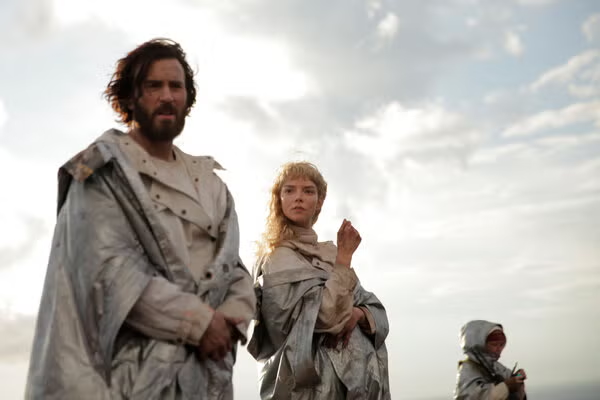
As the festivities wind down, the facility is invaded by a group of eco-terrorists. Its leader, Joan (Anya Taylor-Joy) is convinced she is part of a prophecy that predicts she and three others must be sacrificed in a nearby volcano to prevent it from erupting. She’s convinced it will be an extinction-level event. With her cohorts, she takes Tyler, Bracken and an innocent young dancer, mistaken for a virgin, away so they can meet their fiery fate.
The premise is solid enough to build a successful movie around, but this requires the sort of distanced, ironic tone the Coen Brothers apply so deftly. Director Romain Gavras is unable to consistently achieve this and the film veers from parody to drama to broad comedy indiscriminately. As a result, I never got a sense of what the film was trying to be, my indifference to it all growing as it went along.
Evans and Taylor-Joy understand the assignment and produce the movie’s best moments. The unbending ferocity she brings to her role proves an effective comedic counterpoint to Evans’ convincing sense of vacuity. That the characters completely believe in each other but are at cross purposes is rather clever. It effectively underscores the counter messaging that surrounds so many of our most pressing issues. John Malkovich is also able to hold our attention, when he shows up in the third act as Joan’s irate, science-loving father.
Tyler’s identity crisis effectively lampoons Hollywood and how the industry treats actors as commodities. Discarded after his very public blunder, the actor is desperate to be let back in to the land of make-believe, yet longs to truly stand for something meaningful. His desire to be a true hero and not just some movie construct is fertile narrative ground.
Unfortunately, it remains unsown once the film reaches its wacky climax. Tyler’s decision is unexpected and I have a feeling I would have been moved by it, had more time been spent simply focused on him. As it is, Sacrifice suffers from a scattershot approach, introducing vital social issues yet doing little to foster any empathy for them. Streaming on Netflix.


