


Epic Hail Mary a journey too long
Having not read Andy Weir’s novel Project: Hail Mary, I came in cold to Phil Lord and Christopher Miller’s big screen adaptation of the same. It didn’t take long to understand why the book was on the New York Times’ Best-Sellers List for nearly 40 weeks. Knowing that if it ain’t broke, it shouldn’t be fixed, Weir simply took the structure of his successful debut novel The Martian, and replicated it on a grander scale. By creating another sympathetic, Everyman hero, a high-concept premise presented in layman’s terms, and an adventure-laden storyline, Mary was engineered for success.
For the most part, that translates well to the screen. This $200 million epic is a grand visual achievement, as it employs no greenscreen shots, the practical nature of its elaborate sets providing a sense of place in the middle of nowhere. This proves vital as it provides the movie with a degree of realism that conveys the dangers facing our protagonist. As for that character, middle-school-science-teacher-cum-astronaut Ryland Grace, he’s relatable in the best of ways, a reluctant hero whose biggest challenge is not accomplishing the universe-saving mission he’s been assigned, but rather overcoming his own insecurities.
The movie effectively puts us in Grace’s (Ryan Gosling) boots from the start. Waking up from a yearslong suspended sleep, he finds himself on a vast spacecraft hurtling through the cosmos. Suffering from amnesia, he eventually pieces together that he has been sent with a small crew to find a solution as to why the sun’s power is dimming. He finds that every one of his fellow crew members has died and is now faced with learning their responsibilities as well. In his mind, the success of this mission has plunged to near zero.
However, he gets some help from the most unexpected of sources. He rendezvous’ with another spacecraft, this one from the planet 40-Eridani. Seems its inhabitants rely on the same sun for life and have dispatched their own team to solve this problem. Ironically, it too only contains one survivor, an eyeless, five-legged, stone-like creature Grace dubs “Rocky.” Together they set out to find the solution to their shared intergalactic dilemma, an unexpected bond growing between them.
While this provides the crux of the narrative, it’s interspersed with flashbacks which explain just why the sun is failing, how this international crisis led to unprecedented global cooperation and just why and how Grace ended up on the mission. In addition to Grace, the key figure in these scenes is Eva Stratt (Sandra Huller), the head of the titular mission. Her steely demeanor belying her true nature.
Credit Lord and Miller for keeping a handle on such a vast production and storyline. What with the “21 Jump Street” parodies being their largest movies to date, this is a huge step forward and they prove up to the task. Successfully blending pathos, drama and humor, they manage to keep what could have been an unwieldy story buoyant and engaging. As for the production itself, you can tell every penny of the budget is on screen, the film sporting an epic feel that proves immersive.
As for Gosling, he takes a while to find his footing. His inability to pull off physical humor is a hinderance in the early going, Grace stumbling about his ship again and again in an effort to get his bearings. However, once he settles in, the actor finds his rhythm, his scenes with Huller, who is excellent, being among the film’s highlights. Gosling has always struck me as a cold actor and while I would have preferred that he showed a bit more emotion throughout, your mileage may vary on that count.
As much as I liked the movie’s first two hours, its final 30 minutes dampened its appeal. Rather than ending once the initial conflict is rectified, a further narrative complication is introduced that lessens the film’s overall impact. Having just been put through the emotional wringer, I wasn’t ready to be manipulated once more. And once this extra crisis is solved, we’re made to sit through a superfluous epilogue. It’s all anticlimactic and a regrettable approach to this crowd-pleaser.
Be that as it may, like The Martian, this contains a vital, timely message. Sacrifice and cooperation are the keys to survival, whether it be here on Earth or in the cosmos, while acts of heroism can come from any of us. These common-sense notions are writ large and effectively conveyed in Mary, themes that manage to still resonate despite the film overstaying its welcome. In Theaters.
Blinders ends on a bloody high note
After six seasons, the British crime series Peaky Blinders comes to a fitting end with The Immortal Man, a feature film that brings to a close the saga of Tommy Shelby. Accurate period production values, a poignant script from the show’s creator Steven Knight and strong performances from series veterans and newcomers alike, combine to provides a gripping and satisfying conclusion to its anti-hero’s story arc.

Though he’s gone into hiding on a crumbling country estate, Tommy (Cillian Murphy) isn’t alone. Haunted by past misdeeds, the specter of family members who have died because of his actions is never far from his mind. Wanting to set the record straight, and perhaps purge himself of his demons, he’s set out to write his memoirs. Initially, this practice does not prove productive as, instead of providing catharsis, it dredges up that which should be forgotten.
It’s almost as if this practice conjures an unwelcome visitor in the form of Kaulo Chirikio (Rebecca Ferguson), a gypsy who claims she can help Tommy put his past behind him. Just what her connection is to the Shelby clan and what she wants of them remains a secret. That she has an ulterior motive goes without saying. Perhaps most importantly, she tells Tommy that his bastard son, Duke (Barry Keoghan) has taken over the Peaky Blinders gang. The young man has entered into an arrangement with John Beckett (Tim Roth), a Nazi-sympathizer who’s been charged with spearheading a mission to bring the British economy to its knees. He intends to flood the marketplace with millions in counterfeit currency. The Blinders are to help facilitate this, Duke unconcerned by what the fallout might be.
Of course, it’s inevitable that Tommy will be sucked back into his old way of life, but it’s too Knight’s credit that he doesn’t rush this. The first hour is spent re-establishing this world and the supporting characters, chief among them, Tommy’s sister Ada (Sophie Rundle), while providing vital background on Duke. Perhaps more importantly, this deliberate pacing reminds us of the reasons for the weight Tommy is carrying, the many losses he’s suffered movingly recounted.
It comes as no surprise that Murphy brings the proper gravitas to the role. Reserved throughout, he’s coiled and ready to strike at the least provocation, years of repressed anger roiling beneath the surface. But it’s the haunted look Murphy employs that makes Tommy a tragic figure, his world-weary expressions and measured actions all employed to create a character who is more than ready to shuffle off his mortal coil. Murphy grounds and commands each scene he’s in; you just can’t take your eyes off him.
The supporting cast compliment him in their own ways, Ferguson properly mysterious and sexy, ably leading Tommy down a path he shouldn’t take. Keoghan is saddled with a rather one-dimensional role but to his credit, subtly projects sincere traces of pain beneath the acts of violence his character’s compelled to make. Roth does what he can with the common villain he’s been saddled with, while the return of Stephen Graham as Hayden Stagg is nothing but an extended cameo.
While the movie successfully wraps up numerous storylines, there remain many narrative strands ripe for possible development. With each season of the show only running six episodes, Knight has always been keenly aware where taxing his audiences’ patience is concerned, neither the series nor Immortal Man, suffering from narrative bloat. Were he to adhere to this approach, and continue to provide the kind of fascinating, morally conflicted characters that have become a franchise cornerstone, a continuation of Peaky would be most welcome. Streaming on Netflix.
Though flawed, Undertone still packs a punch
Ian Tuason’s Undertone proves to be an auspicious debut. At times genuinely unnerving, the low-budget feature gets a great deal of mileage out its single-set location, miniscule cast and elaborate sound design. Yet, there’s room for improvement as well. While Tuason’s premise is sound, his approach is needlessly convoluted, the pacing so deliberate that it dulls the impact of the final reveal. Still, there are moments when it all comes together and manages to get under your skin in a way that only the best horror films can.
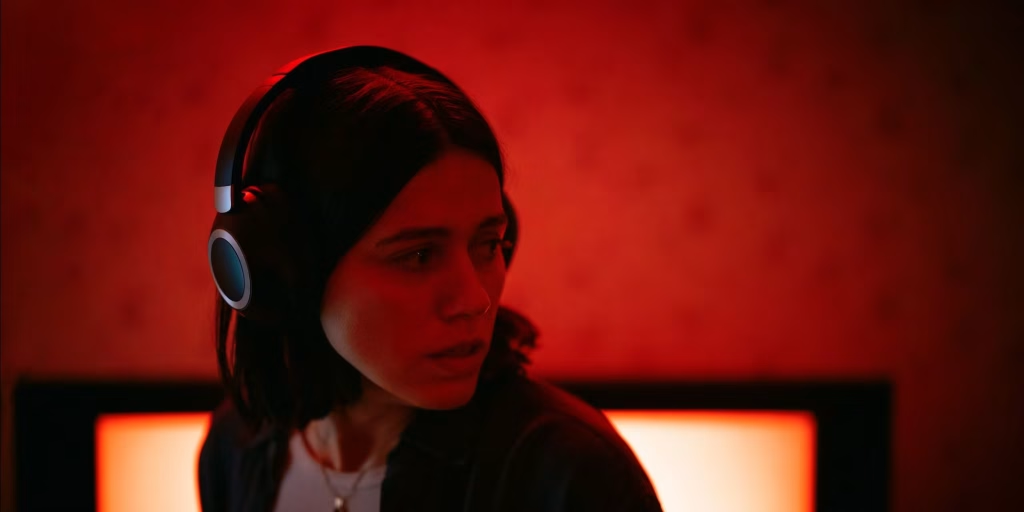
Evy (Nina Kiri) is beginning to buckle under the weight she’s shouldering. Having returned home to care for her terminally ill mother, the sense of isolation she feels has become oppressive. Wracked with guilt and resentment, the only respite she gets is when she records her weekly podcast, The Undertone, with her friend Justin (voice by Adam Dimarco). The program examines reports of paranormal activity, she taking the role of the skeptic, her counterpart more apt to believe in things that go bump in the night.
The episode they are currently recording focuses on an anonymous email Justin’s received containing 10 separate audio files. They are of a married couple, Jessa and Mike (voices by Keana Lyn Bastidas and Jeff Yung). She’s pregnant and doesn’t believe him when he claims she’s been talking in her sleep. To prove her wrong, he begins to record her and what begins as a humorous exercise soon takes a sinister turn. Jessa begins having nightmares and speaking in other voices, all of this revealed as Evy and Justin listen to the files, each becoming more and more disturbing.
These events play out over the course of a couple of weeks, during which we learn more about Evy and her relationship with her mother. Religious elements are introduced, the elder being a devout Christian, her daughter a non-believer, while the subtext of the files Evy and Justin have been listening to are explored. The latter believes that children’s songs such as “Baa Baa Black Sheep” and “London Bridge” can be heard when the recordings are played backward. Digging into the songs’ history, the pair discover the sinister background of each.
Of course, all of these elements are connected and witnessing how Tauson connects these narrative dots is impressive. It’s striking just how dark the story becomes, the horrific elements and themes sinking to a far more disturbing level than first suggested. The resolution is one that becomes more upsetting upon reflection, the far-reaching implications of Evy and Justin’s actions only becoming clear after further consideration of the shocking conclusion.
And yet, as well-done as the film is, it could have been better. While I appreciate a good, slow burn movie, Tuason pushes this approach to the limit. The time that passes between recording sessions of the podcast serves no purpose. While this is meant to build anticipation, these prolonged breaks between the listening of the cryptic audio files instead breed a sense of frustration and impatience. As a result, the first half of the movie suffers from pacing issues, the story moving in fits and starts before finally building the necessary momentum.
Credit Kiri for anchoring the film. Other than the actress playing Evy’s bedridden, silent mother, she’s the only one who appears on screen. The success of the movie rests on her shoulders and her ability to portray the gradual unraveling of her troubled character is effective and sympathetic. As for Tuason, he’s created a genuinely disturbing if flawed, piece of work with Undertone, yet it is a film that portends great things for the young director. In Theaters.
This article appears in March 19-25, 2026.


