

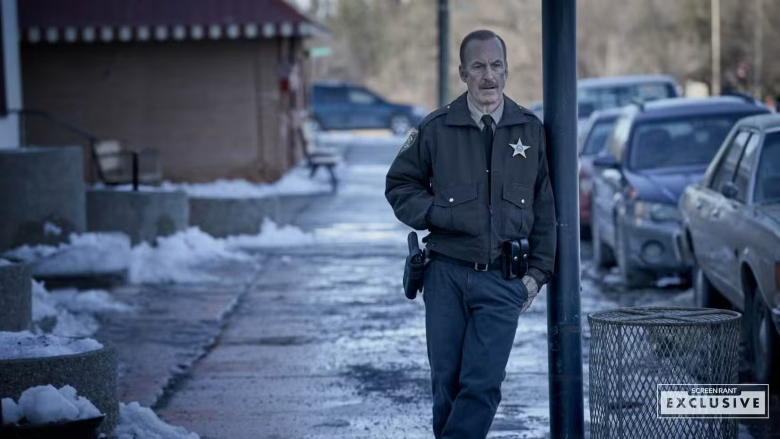
Bloody humor a winner in Normal
I wouldn’t have expected Bob Odenkirk to take the Liam Neeson route to map out the final act of his eclectic career. Having cut his comedic teeth as a writer at “Saturday Night Live” and co-creator of the groundbreaking sketch comedy series “Mr. Show,” he proved he had dramatic chops as well in “Breaking Bad” and “Better Call Saul.” Shifting gears with 2021’s Nobody, the actor was cast as just another guy trying to live a normal life in the ’burbs, yet finds he can’t outrun his past. That the film was a hit was due in no small part to Odenkirk’s everyman quality and innate affability.
Yet, unlike Neeson, the actioners Odenkirk’s appeared in maintain a sense of quality and, with his latest, Normal, are, in fact getting better. To be sure, three movies are a small sample size, but the distinction between fare like Neeson’s Black Light and Retribution, and Odenkirk’s features is in their tone. There’s a post-modern sensibility to Nobody and Normal that makes the mayhem go down easier. Tongue is planted firmly in cheek throughout, Odenkirk and his castmates conveying they don’t believe a bit of what’s happening and you shouldn’t either. These are movies where you’re meant to check your brain at the door and settle back to revel in the ridiculousness of all that’s playing out before you.
That may seem an odd request regarding a movie that features carpenter nails being run into eye sockets and the titular town’s mayor being blown up, but it is what it is. Credit director Ben Wheatley with not only creating the darkly comic tone that allows such scenes to be funny but the film’s crisp pace which keeps things humming from one set piece to the next.
Odenkirk is Ulysses Richardson, interim sheriff for the town of Normal, Minnesota. Seems his predecessor died under mysterious circumstances and he’s there to fill in until the next election in eight weeks. Though he has a laidback demeanor, that doesn’t mean he’s not keenly observant of his surroundings. Richardson can’t help but notice that while most small town American main streets are littered with vacant shops, Normal’s is thriving, with the construction of a new multi-million-dollar courthouse set to anchor it all. Our hero begins to suspect something’s not quite right in this part of the state of Minnesota.
His suspicions are validated when a botched bank robbery reveals the town is a front for the Yakuza who, making more money in the States than they know what to do with, launder and store it in this out-of-the-way burg. Seems all the townsfolk are aware of this, each getting a healthy monthly subsidy, all of them set to protect these ill-gotten gains, knowing the wrath of the Yakuza will descend on them if they don’t.
Before that can happen, Richardson and the two hapless thieves (Brendan Fletcher and Reena Jolly) are forced to defend themselves against the army of Normalites, some adept with the high-powered weaponry at their disposal, some not. This results in some rather clever, albeit grisly set pieces that simultaneously elicit laughs as well as groans, none of which you are allowed to dwell on as Wheatley moves on to the next.
The script by Odenkirk and Derek Kolstad is well-constructed, the final act containing one clever surprise after another. The climax takes place in a bar festooned with hundreds of rifles decorating its walls. The question as to whether they’re loaded or not, asked earlier in the film, is answered in a spectacularly gruesome fashion during a sit-down meal with the locals and visiting Japanese gang members. Needless to say, far fewer walk out than had walked in, the action that ensues being inventive, well-choreographed and not without a laugh or two.
Obviously, Normal will not be everyone’s cup of tea. Far from subtle and containing little in the way of nuance, it proves most effective when its hero stoically reacts to its characters when they realize too late that they’ve bitten off more than they can chew. Like when a deputy gets his ear shot off and tries to reattach it. Yeah, it’s that kind of movie. In Theaters.
Balls gleefully tests the boundaries of good taste
There are some films you can’t defend and Peter Farrelly’s Balls Up is one of them. Revolving around ever evolving, inventive uses for a revolutionary prophylactic, the movie is pitched toward men whose inner teenager is never too far away. Sophomoric and crude, the script by Paul Wernick and Rhett Reese revels in its ribald nature. I wouldn’t be surprised if each writer was trying to top the other where concocting disgusting sight gags are concerned.

As with all comedies, there’s a “your-mileage-will-vary” quality to it. Some will embrace its audacious nature; others will be repelled by it. Certain viewers will bust a gut watching Mark Wahlberg and Paul Walter Hauser trying to swallow large, densely-packed condoms of a very particular shape, while others will lament the devolution of American film comedy and fear those who laugh at such low-hanging comedic fruit.
As all comedy is subjective, none of these opinions are necessarily right or wrong, and while I personally am not a fan of low-brow humor, if I’m in the right mood, I find a fart joke just as funny as the next guy. I must have been in such a state while watching “Balls” as I laughed far more than I’d care to admit and found Wernick and Reese’s script to be inventive. But that’s just me.
The fate of the Regal Blue Condom Co. relies on the World Cup soccer tournament. Apparently, more of these economical rubber barriers are sold over the course of this sporting event than at any other time, so it’s essential they capitalize on this. Elijah (Hauser), of the research and development department, has come up with a better mousetrap where the company’s product is concerned. He’s invented an extra-long prophylactic that covers the traditional real estate as well as the extras alluded to in the film’s title. And while everyone at Regal Blue acknowledges Elijah’s genius, it’s a given he’s no salesman, so he’s paired up with Brad (Wahlberg), a hot shot from sales who could sell a refrigerator to an Eskimo.
The odd couple set out to present their pitch to the Brazilian Travel Ministry and while it’s a success, a night of excessive celebratory partying leads to a series of increasingly ridiculous misadventures. Before all is said and done, the pair affect the outcome of the World Cup Championship game, are hunted by the entire populace of Brazil, abducted by a drug lord (Sascha Baron Cohen), attempt to outrun the country’s Ministry of Defense, abscond with a cache of cocaine, accidentally kill an alligator, fall in with a group of eco-terrorists and belt out a duet of Gotye’s “Somebody That I Used to Know” for the ages.
You have to give the cast members credit as each of them is fully committed to their characters. Benjamin Bratt has never been funnier as Santos, a nine-years sober Brazilian executive who Brad and Elijah push off the wagon with a vengeance, while Molly Shannon as their foul-mouthed boss delivers the funny in each of her short scenes. As for Wahlberg and Hauser, their antagonistic chemistry produces one genuinely funny moment after another, the pair equally adept at witty banter and wordplay as physical comedy.
I’m not proud that I laughed at the numerous jokes relating to private parts, the obvious gags related to human resource violations, a bit involving a urethra-invading fish or the numerous inappropriate one-liners Balls contains. But I’m not going to apologize either. With the world in the state of turmoil as it is, I’ll take some laughs wherever I can find them. Streaming on Amazon Prime.
Reeves shines in flawed but intriguing Outcome
The vast majority will never know the burden of being a celebrity. While fame, fortune and everything that goes with it may seem attractive from a distance, the isolation that comes with it is a challenge many have wilted under. With your every moment under the microscope and your past scoured by scavengers looking for minor, years-old, youthful transgressions to inflate for their own gain, the upside to this kind of notoriety hardly seems worth the trouble. That being adored and cut-off would affect your mental health is without question; how you deal with that is the test, one few seem to survive unscathed.

This is the subject of Jonah Hill’s intriguing yet flawed new film Outcome, a darkly comedic look at the pressure a beloved Hollywood star endures and its effect on his sanity. Co-written by Hill and Ezra Woods, the movie comes with a sense of authenticity, what with the filmmaker’s many years dealing with Tinsel Town eccentrics. That it presents an exaggerated version of Hollywood’s fame dynamics, is obvious. What’s not so, and more disturbing, is how much or how little Hill is stretching the truth.
A bit of meta casting is at play, at least to a certain extent, with Keanu Reeves appearing as Reef Hawk, the actor universally known as the “nicest guy in Hollywood.” (Reeves is often referred to as such.) Problem is, that’s a bit of a sham as his boorish, self-centered behavior has been covered up by his agent, handlers and self-serving best friends (Cameron Diaz and Matt Bomer) for years. Having been in front of the camera since he was 10 years old, the actor has taken a prolonged break to recharge. Truth be told, he’s been trying to shake his drug habit and is ready to return to the big screen with a shaky sense of sobriety.
However, this is derailed when Hawk gets a call from his crisis attorney Ira Slitz (Hill). Seems someone has a bit of video from the actor’s past showing him in a less than admirable light. $15 million is the price for it not to be sold to the media. Not sure who’s making the threat, Hawk goes on an apology tour, visiting his ex-manager (Martin Scorsese), his mother (a fantastically foul-mouthed Susan Lucci) and his ex (Welker White). He’s hoping one of them is the blackmailer and his making amends will stop them from carrying through on the career-ending threat.
Reeves, who’s allowed his stoicism to become a crutch at times, delivers a genuinely poignant, and perhaps, his best performance. Subtly conveying a sense of confusion and pain while trying to maintain Hawk’s slipping public persona, the actor finally uses his less-is-more approach to great effect. This is crucial to the film’s success as he provides the only sincere character we can relate and sympathize with amidst the charlatans that surround him.
Hill, at times, seems unhinged as Slitz, his narcissism overpowering everyone and everything in each scene he appears. But then the other shoe drops at the end of the second act, a scene playing out in which we see a more compassionate side of him that’s as sincere as his business acumen is false. Survival in Hollywood requires compromise of character, a slippery slope that can become all consuming. Keeping his work and private lives separate was never an option for Hawk, his loss of identity so much collateral damage in his mother’s quest for fame. And while Outcome may take place in a land of make believe, its lesson has real world implications we would all do well to remember. Streaming on Apple TV+.


