

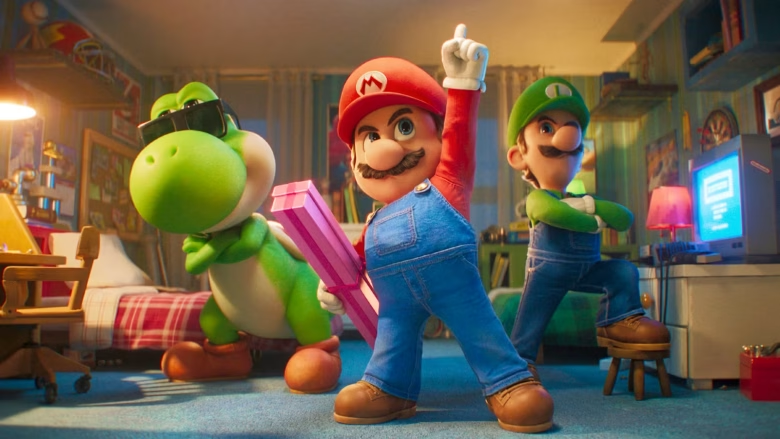
Galaxy simply goes through the motions
I have yet to be blessed with grandchildren. Still, that doesn’t prevent me from casting my thoughts toward future events I hope to share with them. I look forward to birthday parties in which my wife and I will spend far too much money celebrating their arrival; I see Christmases when I’ll gleefully witness their surprise upon opening presents; I envision taking them on vacations and living vicariously through them as they see for the first time wonders I’ve come to take for granted. And, of course, sharing films I love with them, hoping they’ll appreciate them as much as I do.
However, one thing I don’t look forward to and fear I will be roped into doing anyway, is going to see things like The Super Mario Galaxy Movie. To be sure, they’ll likely be enraptured with whatever seizure-inducing cacophony passes for entertainment in 2036. The Charlie Chaplin and Buster Keaton shorts I’ll be showing them will hold no sway over the seductive power of the visual entertainment they’ll be bludgeoned with.
I sympathize with any grandparents who, wanting to give their kids a break by suggesting they spend some time with their grandkids, wind up at the local multiplex and stumble into Galaxy. Don’t fall victim to your grandson’s pleas to see it or your granddaughter’s sad doe-like eyes. Remember, telling them “no” is not the end of the world, and while I never bought into the notion that experiencing disappointment builds character, I’m sure some good must come from it. However, if you’ve already foolishly agreed to take them, let me prepare you.
Despite having no knowledge of the Mario universe, my editor requested I review the first movie in the series and, if memory serves, it wasn’t a completely unpleasant experience. I wish I could say the same regarding the sequel.
The plot, the most inconsequential aspect of the movie, is basically the same. Yet another princess is kidnapped, this time it’s Rosalina (voice by Brie Larson). She’s been abducted by Bowser Jr. (Benny Safdie) who needs her power to run his Boomsday cannon, which he intends to use to control the universe. This is all done in an effort to impress his father, Bowser Sr. (Jack Black), who’s been imprisoned by Mario (Chris Pratt) and Luigi (Charlie Day).
These two siblings saved the day in the previous film, having come to the aid of Princess Peach (Anya Taylor-Joy), who happens to be Rosalina’s sister. Hearing her sister has been taken, she sets out to save her, the brothers soon coming to her aid.
What ensues are a series of fights, traps and rescues rendered in the manic fashion that’s become the norm. I’ll say one thing for the film – it’s bright! While I don’t often recommend seeing movies in 3-D, the screening I attended was in that format and the dark glasses came in handy. In dulling the Technicolor nightmare I was being subjected to, I’m sure I escaped a case of retinal scarring.
Obviously, I am not the audience this film is pitched to and anything I or any critic says will not prevent it from grossing $1 billion. This is not so much a movie as it is a big screen example of gameplay fans of the franchise will recognize and nothing more. Familiar dopamine centers will be stimulated and all will go home happy.
And while Galaxy was made by the same directors, Aaron Horvath and Michael Jelenic, as the franchise’s first entry, the tone of the sequel is decidedly different. There was a sense of joy and fun in the previous movie that was infectious. Even I found myself somewhat engaged and charmed by that effort, feelings that were absent this go around. There’s a sense here that all involved are simply going through the motions, something that does not bode well for the many sequels to come or the non-fans who will have to endure them. In Theaters.
Life lacking critical eye
Slight but well-meaning, Matthew Shear’s Fantasy Life is a vanity project that aimlessly meanders about before reaching its predictable conclusion. Taking place in the rarified section of New York society Woody Allen first gave us a glimpse of, the story moves in fits and starts, introducing numerous situations that go undeveloped, all in service to a hard-to-swallow premise that becomes more ridiculous as it unfolds.

Sam (Shear) suffers from debilitating anxiety, a condition that leads to him losing his job at a New York City law firm. Seeing his therapist, Fred (Judd Hirsch), in an effort to get a handle on the situation, the doctor’s wife, Helen (Andrea Martin) offers him a babysitting job. Seems her son, David (Alessandro Nivola) and his wife, Dianne (Amanda Peet) are in need of someone to watch their three girls, Emma (Riley Vinson), Zoe (Romy Fay) and Claire (Callie Santoro). With no other prospects, he accepts.
What Sam doesn’t realize is that he’s stumbling into a marriage in crisis. Dianne’s once fruitful acting career has stalled – she hasn’t worked in 10 years – while David is restless, the musician agreeing to go on an international tour to get some distance and stroke his ego. Neither wants to admit that a tipping point in their relationship is rapidly approaching.
Shear’s script is choppy and at times disjointed. At multiple times, the story jumps months ahead, robbing the viewer of scenes covering the developing relationship between Sam and his three charges, the disintegration of Dianne and David’s union and other key points that are in dire need of further explanation. That the story is hard to become engaged in comes as no surprise.
If there’s ever been an example of a veteran cast making material better than it is, this is it. Nivola finds the perfect narcissistic pitch to capture David’s casual egotism but his vulnerability as well. That you sympathize with him is a tribute to the actor’s impressive high-wire act. In addition to Hirsch and Martin, Bob Balaban and Jessica Harper are on hand as Dianne’s parents, these four veterans perfectly finding the deft touch needed to make their characters distinctive but not overbearing, There’s a great deal of acting muscle memory on display.
However, its Peet who’s the focus, the actress finally getting a role deserving of her underused talent. Wearing little make up throughout, she uses her still beautiful but weathered face to her advantage, it helping to convey Dianne’s battered psyche. Vacillating between moments of desperation and despair to those of anger and strength, in Dianne she creates a portrait of a woman in crisis, her mental health issues allowing her to appear functional but little else. It’s a subtly moving turn, the character relatable and recognizable thanks to Peet’s fine work.
As for Shear, he’s the weak link on screen, not able to keep pace with his more experienced co-stars. He’s unable to generate any real sympathy in Sam, which is a fatal flaw. While we connect with Dianne, he remains a collection of quirks rather than a genuine character, undercutting the filmmaker’s theme.
With his intent on examining and dispelling the stigma of mental illness, Shear’s on thematically solid ground. Unfortunately, directing, writing and acting in your first feature film is seldom a recipe for success. An objective set of eyes is necessary to avoid the many pitfalls that come from wearing these three hats. Fantasy would have benefited from having a more critical eye applied to its making, one that might have helped define its protagonist more fully and drive home its point with greater impact. Available through Video-On-Demand.
This article appears in April 2-8, 2026.


