


EPIC showcases the King in his court
While in the process of making Elvis, director Baz Luhrmann, was informed there was footage shot for the concert films That’s the Way it Is, and Elvis in Concert, that had never been used. The problem was, no one knew where it had been stored. His production assistants began an extensive search in the MGM document archives and found there were 69 boxes of film sitting in a salt mine outside Kansas City where the studio stored thousands of canisters of nitrate stock. Once the boxes were located, 59 hours of unseen footage of Presley was found, none of it having been seen by the public.
After two years of restoring the film and tracking down missing sound tapes that had been misplaced, the end result is EPIC: Elvis Presley in Concert. The movie, like other concert films, reminds us of the live-wire energy Presley had on stage, but more importantly, provides an intimate look at the man behind the image. Luhrmann and editor Jonathan Redmond have honed the treasure trove of footage down to a tight 90-minute movie that, at times, is overwhelming. However, unlike so many modern, action epics, the film never comes off as an assault on the viewer, but rather an immersion of all things Elvis, an experience as close to seeing him in concert as today’s fans are likely to get.
The filmmaker’s approach is enthralling from the start. The first 10 minutes consists of archival footage from Presley’s early days, showing him preforming as a newcomer on local stages before graduating to larger venues and the movies. The editing of these scenes increases in speed, reaching a crescendo with the singer’s induction into the Army, the whole process starting again with his return to civilian life, his resumption of his music and movie career and the rise of the British Invasion. All of this is underscored by raucous renditions of Presley’s early hits, this summation of the “story ’til now,” a rousing preamble of what’s to come. That you’ll likely be rocking in your seat by this point should come as no surprise.
Glossing over the historic 1968 comeback television special, the movie jumps ahead to 1969, the singer seen in rehearsal sessions for what would be a precedent-setting residency at the Las Vegas International Hotel. It’s during these moments, as well as in clips from various press conferences that are interspersed throughout, that we see Presley with his guard down.
It’s obvious that, in watching his interactions with others, that stardom hadn’t changed the core values of the man. Whether speaking with fellow musicians, entertainment peers or his adoring fans, Presley is always polite and often self-depreciating. Here is a man with the world on a string, constantly in the public eye. Rather than seeming inconvenienced or impatient to be alone, we see him taking great joy in interacting with others. Never disingenuous, he’s genuinely engaged with whomever he’s talking to, not a shred of artifice on display. We see a man that, though committed to his work, is eager to have fun and put a smile on the face of anyone he encounters. His meeting with fans is most telling, Presley actually taking time during his concerts to walk through the audience, feeding off their adulation. This symbiotic relationship speaks to the unique relationship the performer had with his followers, a devotion that endures long after his death.
While the initial concert scenes are moments from the opening night of his residency, as the film progresses, Luhrmann and Redmond begin to employ footage from other shows later in Presley’s career. While the singer’s enthusiasm remains, the strain of his constant performing becomes obvious. Seen exerting himself to the point of exhaustion repeatedly, we become witness to the legend wearing down before our eyes. That he was able to keep up the pace of two shows a day, six days a week over the course of five weeks is remarkable; that this schedule and its ripple effects would lead to his untimely death is not surprising.
Yet, EPIC does not dwell on these points; this is a celebration of Presley’s unique talent, showcased with reverence throughout. Whether tearing through “Hound Dog,” serenading the audience with “Can’t Help Falling in Love,” or pointing toward social issues with “In the Ghetto,” there’s a passion in the singer’s approach that’s captivating and infectious. Luhrmann’s admiration for his subject is obvious and his spreading the Gospel of Elvis is a mission he willingly embraces. EPIC will remind longtime fans of why they first became enamored with Presley. If there any non-believers left, this film will likely convert them. In Theaters.
Kinetic GOAT perfect for the younger set
I’m quite sure the kids and pre-teens Tyree Dillihay and Adam Rosette’s GOAT is aimed at will enjoy it. Based on the experiences of NBA superstar Steph Curry, who serves as one of the film’s producers and has a small voice role, the movie is a kinetic, visual and aural onslaught that bombards the viewer for most of its 100-minute running time. For the generation brought up with a smart phone or tablet used as a babysitter, this will seem like yet another bit of overstimulation their minds have become accustomed to. However, for anyone older than 20, GOAT ultimately becomes a trial, a headache-inducing barrage that is endured rather than enjoyed.
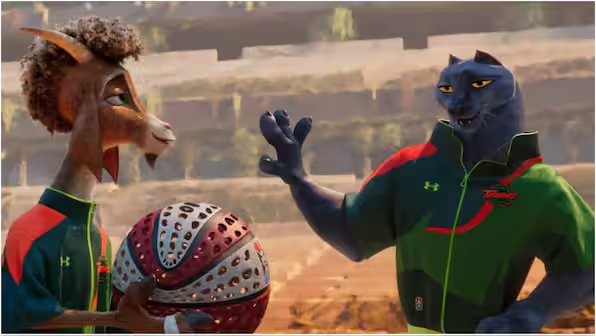
Roarball is the name of the game that Will Harris (voiced by Caleb McLaughlin) longs to succeed at. Unfortunately, the young goat is going to have his work cut out for him. This variation on basketball is a gladiator sport dominated by rhinos, gorillas, horses and bulls, these creatures running through and over each other before literally smashing the boards. Still, the kid’s quick, can shoot from the outside and has a tenaciousness that just might make him a star … if, he can catch a break.
Which just happens to come during a local pick-up game. The stallion, Mane Attraction (Aaron Pierre), a master of trash talk and braggadocio, takes on all challengers and grossly underestimates Will. And while our young hero ends up losing the match-up, his unorthodox skills are put on display via social media. This catches the eye of the owner of the Vineland Thorns, porcine owner Flo (Jenifer Lewis), who’s looking for a cheap way to get her team out of its funk.
Much to Will’s delight, he’s signed to join the squad. But this does not sit well with the Thorns’ veterans, particularly Jett Fillmore (Gabrielle Union), a ball-hogging panther who’s never been able to bring home a championship. She, as well as her teammates, Archie (David Harbour), a gone soft rhino, Lenny (Curry), a demoralized giraffe, Modo (Nick Kroll), an odd Komodo dragon, and Olivia (Nicola Coughlan), a social media addicted ostrich, make it clear they have no interest in Will.
The underdog scenario is a perfect hook for young viewers and with Will’s genial nature and can-do attitude on display they’ll be in his corner from the start. Equally engaging are the dynamic and imaginative visuals. The various arenas where the Thorns play are a reflection of the ecosystem where they’re located. The Cave is just that, the players forced to dodge falling stalactites, while the Inferno sits on top of a volcano and poses a variety of heat related obstacles, and the Cryosphere is played on a massive sheet of ice. These locales are vibrantly and meticulously rendered, as are the animal creatures, each making an immediate and lasting impression.
The voice cast deliver performances as distinctive and loud as their visual counterparts. As such, they can be a bit much. However, Patton Oswalt is the most effective as the Thorns’ coach Dennis, a proboscis monkey who, when rediscovering his passion for roarball, delivers one stroke-inducing speech after another.
There are few surprises where the film’s conclusion is concerned and that’s fine. The purpose of GOAT is to inspire the still-impressionable and it succeeds. And while young viewers will be please, parents and other older patrons will likely need to lie down after enduring the movie’s relentless visual assault. You’ve been warned. In Theaters.
Song and sentiment in tune in surprising K-Pops!
A primer to K-pop music and a loving tribute to American rhythm and blues, Anderson Paak’s K-Pops! was born out of his son’s passion for the South Korean music that’s become a global sensation. During the Covid-19 lockdown, the Emmy-winning producer was schooled by his son, Soul, on all things K-pop. Fascinated, he realized that through this he would be able to teach the young man about his own musical heritage, drawing connections between BTS and Earth, Wind and Fire among others. These teachable moments eventually prompted Paak to imagine a fictional version of their story, this surprisingly entertaining movie, being the result.

Paak is BJ, a drummer who’s his own No. 1 fan. Passionate about his music, he’s been laboring at a Los Angeles bar for more than a decade, getting nowhere in his pursuit of stardom and, more importantly, validation. Down to his last dime, he allows his friend Cash (Jonnie Park) to set him up with a lucrative gig. The problem is, it’s in South Korea on a music competition show called “Wildcard.” Out of options, the disgruntled drummer takes the job and heads east.
Though it takes him a bit to find his footing in the new culture, the percussionist soon comes to appreciate the talent of those he’s backing up on stage. Sixteen young singers and dancers are vying to be named the winner of this annual contest, which captivates the country each year. Among the hopefuls is Tae Young (Soul Rasheed), an affable young man who may not have the slick moves of his main competition, Kang (Kevin Woo), but has a passion BJ recognizes. Soon, the veteran takes him under his wing in an effort to guide him to the winner’s circle.
Paak is a surprisingly charismatic actor, charming us despite his character’s initial immature appearance. There’s a mischievous side to him that proves winning, his smile melting away any misgivings one might have about his intentions. His musical chops are also to be reckoned with, his prowess on the drums as well as in musical arrangement producing catchy and seductive tunes throughout. His son, Rasheed, is equally engaging, the rapport the parent and child display on screen genuine and winning.
Their relationship as well as the cast of broadly rendered characters breathe life into the film’s trite premise, making for a movie that’s more entertaining than it has a right to be. Jee Young Han brings fire and heart to the role of Tae’s mother Yeji, while comedian Cathy Shim’s outlandish show host Diamond manages to get laughs each time she has to put BJ in his place. Park is equally effective as our hero’s older friend who has eyes for his mother Brenda (Yvette Nicole Brown), their comic passion for each other a great counterpoint to BJ’s disgust at the situation.
For newcomers to the K-pop phenomenon, like yours truly, the film is an eye-opening introduction. While BJ hones Tae’s song and dance skills, he breaks down the various components of K-pop, which is more complex than appearances would indicate. Each member in a group has a distinctive persona, while the meticulous nature of the choreography and writing of the songs is impressive. The energy brought to the stage by these young performers is infectious, while the songs, many driven by an over-produced synth beat, are nearly impossible to resist.
While the music in the film may seem like the focus, it’s the relationship that develops between BJ, Tae and Yeji that provides the film with heart and makes it worthwhile. Paak wisely doesn’t overplay these moments, he and his cast bring a sincerity to these scenes that proves surprisingly effective. As a result, K-Pops! winds up being a pleasant surprise, an unassuming movie that succeeds on its own terms. In Theaters.
This article appears in February 26 – March 4, 2026.


